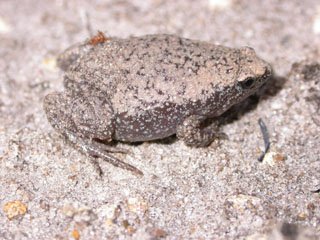
Eastern Narrow-Mouthed Toad (Gastrophryne carolinensis) lives in eastern woodland edges across Southeastern US (MD to FL, west to MO, AR, TX) plus Iowa. Its conservation status is Least Concern.
Fascinating facts about the Eastern Narrow-Mouthed Toad
- At just 53 mm long, the eastern narrow-mouthed toad is the size of a thumb, yet its skin is tougher than most amphibians, a shield against the ants it devours. Adults range from 22 to 35 mm (0.9-1.4 inches) in body length; females usually attain larger sizes than males and exceed a little over 1.25 inches. Directly behind the eyes a fold of skin can snap shut over the eyes, a unique adaptation that protects delicate vision while the toad probes ant nests.
- Ninety-five percent of every meal is ants, the toad's diet is a near-pure ant buffet. A 2013 study recovered 4,859 individual ants from the stomachs of 146 toads in Florida scrub, and the remaining 266 prey items included 160 mites. Overall, ants and other arthropods make up to 75 % of their diet, with termites, beetles and small snails filling the rest.
- When rain triggers breeding, a single female can lay over 800 tiny eggs that hatch in as little as 1.5 days and at most 3 days. Each floating egg mass holds 10 to 150 eggs, and the embryos develop into tadpoles that metamorphose in just 23-67 days. Males reach sexual maturity in a year, females in 1-2 years.
- If a predator grabs it, the toad releases a noxious skin secretion that burns and tastes terrible, a chemical shield that makes it unpalatable. In experiments, predators refused eastern narrow-mouth toads far more often than control frog species, confirming the toxin's effectiveness. The same secretions also help keep aggressive ants away while the toad feeds. This dual defensive role illustrates how a single chemical weapon can protect adult stages from very different threats.
- From the swamps of Florida to the sand-dune lawns of suburban Texas, the toad tolerates elevations up to 550 m (1,800 ft) and even brackish water on barrier islands. It thrives in both temporary rain-filled ditches and permanent ponds, and can live in urban gardens, pine-oak uplands, and coastal marshes. Such habitat flexibility, combined with a large, stable population, earned it a IUCN status of Least Concern, though copper contamination in wetlands remains a localized threat. Its adaptability shows how a small amphibian can colonize the most varied corners of the southeastern U.S.
Sources
Every fact above was checked against these pages, and kept only where one of them states it.
At a glance
RangeSoutheastern US (MD to FL, west to MO, AR, TX) plus Iowa
HabitatEastern woodland edges
DietInsects and worms
About the Eastern Narrow-Mouthed Toad
In the warm, humid depths of the eastern woodland, a tiny, unassuming monarch navigates the shadows, its mottled brown skin blending seamlessly into the leaf-littered floor. The Eastern Narrow-Mouthed Toad moves with a quiet, purposeful deliberation, its short legs propelling it through the underbrush with a gentle, almost ethereal, ease. As it pauses to survey its surroundings, its large, golden eyes seem to gleam with a deep, ancient wisdom, a testament to the enduring presence of this humble, yet fascinating, creature.
Hear the Eastern Narrow-Mouthed Toad, and 4,400+ more
Real recorded sounds, 11 nature games and a free Daily 5, 1v1 quiz duels, conservation wins and a safe Kids mode. Free on Feravox.
More amphibians to discover