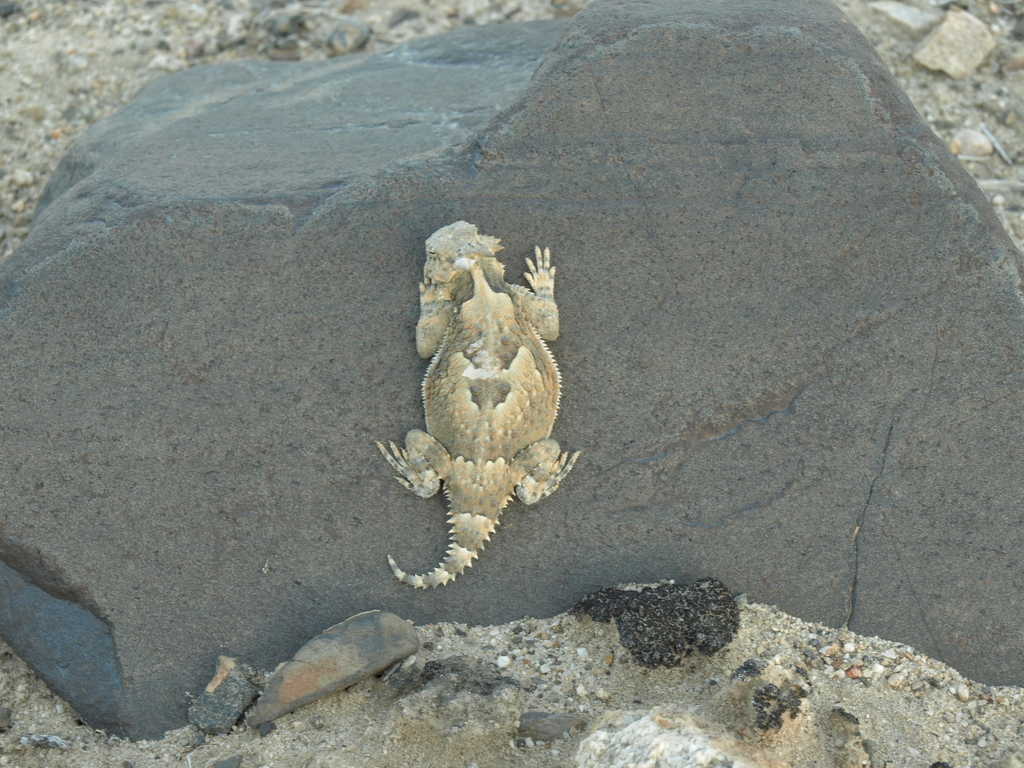
Desert Horned Lizard (Phrynosoma platyrhinos) lives in desert across Southwestern North America. It feeds on ants and beetles. Its conservation status is Least Concern.
Fascinating facts about the Desert Horned Lizard
- A desert horned lizard can stretch out to about 3.75 inches (95 mm). It has a stomach built to take in massive ant swarms. By expanding their gut, they offset the low nutrition of chitin-rich ants.
- Unlike most horned lizards that sit still, desert horned lizards are the sprint-specialists of the group. When startled they bolt, though only for a short burst before pausing again.
- Two subspecies carve out distinct territories across the western U.S. The northern form, P. p. platyrhinos, inhabits Idaho, Wyoming, Utah, Nevada, the Colorado front range, and parts of southeastern Oregon, while the southern form, P. p. calidiarum, lives from southern Utah and Nevada down to southeast California, western Arizona, and northern Baja California.
- When the ice retreated about 21,000 years ago, desert horned lizards sprinted northward, colonizing the Great Basin and reshaping their modern map. The species now stretches from southern Idaho down to northern Mexico.
- Desert horned lizards have been caught rain-harvesting, a trick once thought limited to a few exotic species. In a downpour they tilt their bodies, lowering their mouths toward the wet ground to sip water droplets.
Sources
Every fact above was checked against these pages, and kept only where one of them states it.
At a glance
RangeSouthwestern North America
HabitatDesert
DietAnts and beetles
About the Desert Horned Lizard
In the scorching expanse of the desert, a tiny, spiky sentinel surveys its kingdom, the desert horned lizard watching with wise, ancient eyes as the sandy dunes shift and swirl around it. With a stuttering, stop-start gait, it moves through the arid landscape, its mottled brown skin blending seamlessly into the rocky outcroppings and thorny scrub, a master of stealth and patience. As it basks in the blistering sun, its body drinks in the warmth, fueling a remarkable ability to puff up its skin and deter predators, a clever trick that has allowed this little lizard to thrive in one of the harshest environments on Earth.
Common questions
What does the Desert Horned Lizard eat?
Diet: ants and beetles.
Where does the Desert Horned Lizard live?
Habitat: desert.
Is the Desert Horned Lizard endangered?
The Desert Horned Lizard is listed as Least Concern on the IUCN Red List.
Hear the Desert Horned Lizard, and 4,400+ more
Real recorded sounds, 11 nature games and a free Daily 5, 1v1 quiz duels, conservation wins and a safe Kids mode. Free on Feravox.
More reptiles to discover