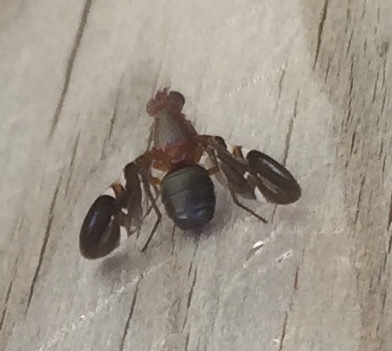
Common Picture-Winged Fly (Delphinia picta) lives in open woodland across Eastern North America. It feeds on flowers and nectar.
Fascinating facts about the Common Picture-Winged Fly
- Delphinia picta is the only species placed in the genus Delphinia, making it a unique taxonomic unit. It belongs to the picture-winged flies of the family Ulidiidae, a group known for their patterned wings. Its distribution stretches across the eastern United States from Florida to Maine and westward to Kansas and Minnesota, and it also occurs in Mexico and El Salvador.
- Mating in Delphinia picta occurs in the evening a couple of days after the adults emerge from their pupae. During this courtship the female gently waves her wings, prompting the male to flick his own wings in response. Both partners may also produce a tiny air bubble from their mouths, adding a visual cue to the wing displays. These coordinated behaviours help the flies recognise each other and synchronise copulation.
- A female Delphinia picta can lay as many as 500 eggs into decaying herbaceous plant material, where the eggs hatch after four to six days. The emerging larvae pass through three instar stages before becoming pupae in 21-30 days, and the pupal stage lasts another 14-17 days. Because the species thrives wherever dead vegetation accumulates, it is found in settings such as landfills, temperate deciduous forests, swamps and shaded fields.
- These flies have been seen feeding on the fermenting droppings of the beetle Megacyllene robiniae. The frass accumulates on black locust trees, tying the fly's diet to that specific insect-tree relationship. Because the flies are detritivores, they exploit the nutrient-rich, decaying material rather than fresh plant tissue. This behaviour is typical in the habitats where decaying vegetation is abundant, such as swamps and shaded fields.
- In laboratory studies most adult Delphinia picta die before reaching forty days of age. A small number, however, have been recorded living as long as sixty-nine days under the same conditions. The short adult lifespan means the flies must complete mating and egg-laying within a narrow time window after emerging from pupae.
Sources
Every fact above was checked against these pages, and kept only where one of them states it.
At a glance
RangeEastern North America
HabitatOpen woodland
DietFlowers and nectar
About the Common Picture-Winged Fly
As the sun casts its warm rays upon the lush vegetation, the Common Picture-Winged Fly, with its iridescent sheen, dances through the air, its delicate wings beating in a hypnotic rhythm. With an effortless elegance, it flits from bloom to bloom, sipping nectar and leaving a trail of subtle wonder in its wake, its very existence a testament to the intricate beauty of the natural world. In its fleeting, whirling movements, we find a reflection of the ephemeral nature of life itself, a reminder to cherish each moment in this vibrant, thriving tapestry.
Hear the Common Picture-Winged Fly, and 4,400+ more
Real recorded sounds, 11 nature games and a free Daily 5, 1v1 quiz duels, conservation wins and a safe Kids mode. Free on Feravox.
More insects and spiders to discover