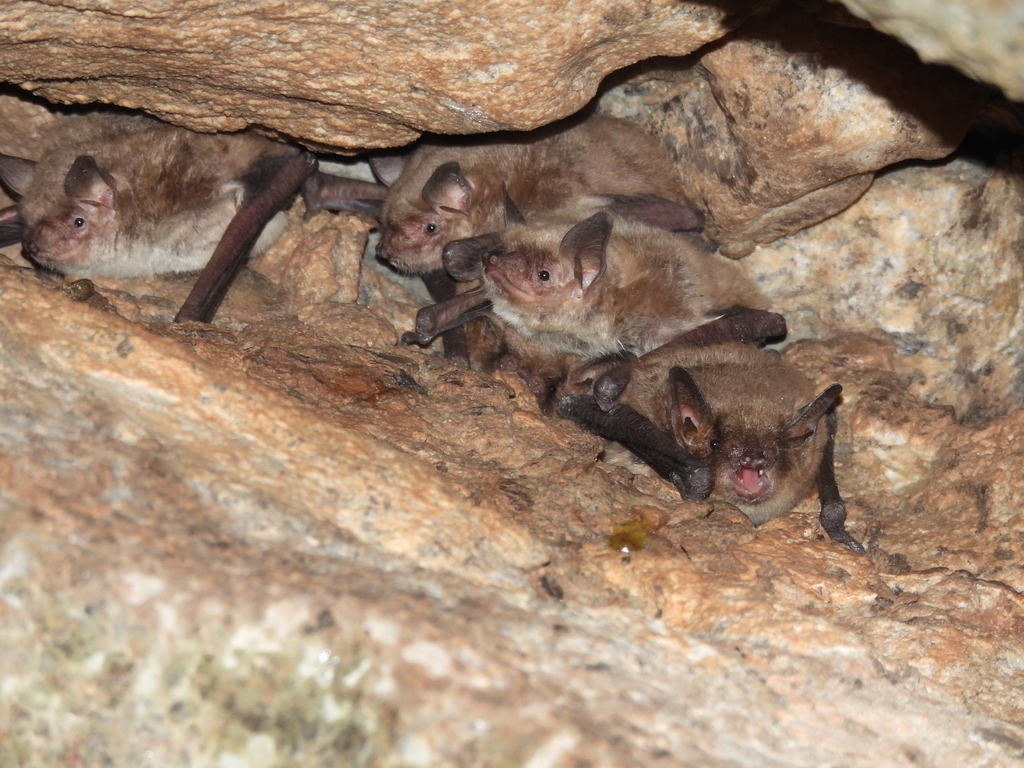
Cave Myotis (Myotis velifer) lives in desert caves across Southwest North America. It feeds on insects and spiders. Its conservation status is Least Concern.
Fascinating facts about the Cave Myotis
- During the cold months the species forms massive winter colonies, with groups of over a thousand individuals hanging from cave ceilings. These aggregations persist from mid-October through April, the period when the bats enter hibernation. Because the caves remain cool, the bats cluster tightly to reduce heat loss, a behaviour that helps them conserve energy throughout the long chill.
- A distinctive bare patch of skin on its back sets the cave myotis apart from other large Myotis species. This unfeathered area is visible when the bat hangs, providing a quick field mark for researchers.
- Unlike most bats, the cave myotis shows a surprisingly weak homing ability, meaning individuals do not reliably return to a known roost after displacement. The reason for this deficiency is not known, but scientists have suggested that bat navigation generally depends heavily on smell and sight. This atypical behaviour makes the species an interesting subject for studies of bat orientation.
- Its larger size and well-adapted wings may allow it to forage farther from its roost than other Myotis bats. It has a forearm measuring 37 to 44 mm, making it bigger than most of its congeners. It usually leaves the cave one to two hours after sunset to hunt, using echolocation to capture moths. In winter colonies over a thousand individuals have been recorded hanging on cave ceilings, showing how many can gather before the nightly forays.
- Juvenile cave myotis begin foraging with adults as early as four weeks old, quickly learning the aerial hunting skills of their mothers. By the time they are six to eight weeks old they consume roughly the same number of insects each night as fully grown bats. This rapid increase in intake mirrors the species' overall pattern of increasing food consumption during lactation and gestation, when females need extra energy.
Sources
Every fact above was checked against these pages, and kept only where one of them states it.
At a glance
RangeSouthwest North America
HabitatDesert caves
DietInsects and spiders
About the Cave Myotis
In the depths of darkened caverns, the Cave Myotis unfurls its leathery wings, taking to the shadows with an ethereal silence, its high-frequency calls echoing off damp stone as it navigates the blackness with ease. With each delicate flutter, it dances through the gloom, a master of the unseen, its large ears tuned to the faintest whispers of the underground world. As it swoops and dives, its agility and precision are a testament to the remarkable adaptations that have allowed this tiny bat to thrive in the most inhospitable of realms.
Hear the Cave Myotis, and 4,400+ more
Real recorded sounds, 11 nature games and a free Daily 5, 1v1 quiz duels, conservation wins and a safe Kids mode. Free on Feravox.
Cave Myotis photographed on Feravox