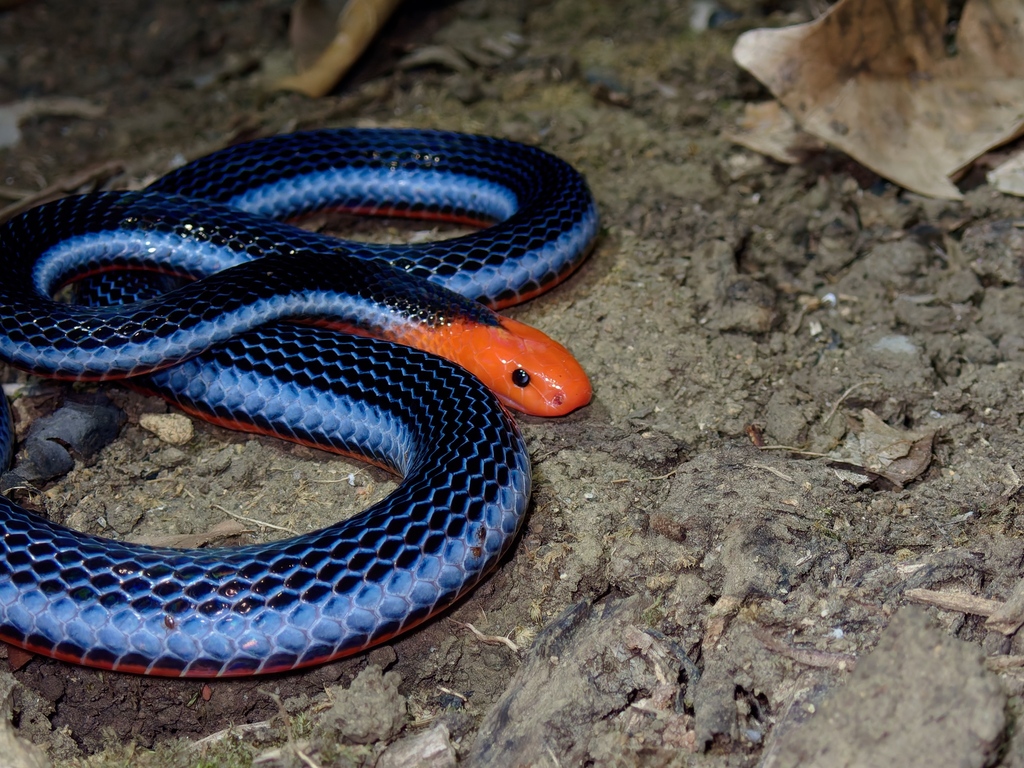
Photo: Jay Paroline
Feravox · The Voice of the Wild
Blue Malaysian Coral Snake
Calliophis bivirgatus
Least Concern
Blue Malaysian Coral Snake (Calliophis bivirgatus) lives in forest leaf litter across Southeast Asia. It feeds on other snakes. Its conservation status is Least Concern.
The blue Malaysian coral snake, Calliophis bivirgatus, glides through the leaf litter of Southeast Asia’s primary and secondary forests with a slender, medium-sized body that can reach 1.8 metres (5 ft 11 in). Its striking coloration, dark blue or black dorsum punctuated by a bold blue or white stripe on each flank, and a vivid red head, tail, and belly, makes it unmistakable to the trained eye, though juveniles are often mistaken for the pink-headed reed snake, Calamaria schlegeli. This elapid’s most astonishing feature lies beneath its skin: venom glands that span a quarter of its body length, producing Calliotoxin, a neurotoxin that freezes prey by delaying sodium-channel inactivation. While bites to humans are rarely fatal, the venom’s unique composition hints at future medical applications for chronic pain. When night falls, the blue coral snake slips between fallen leaves, hunting almost exclusively other snakes, including fellow venomous species. Its semi-fossorial habits keep it hidden, and when threatened it may bolt away, yet sometimes it lifts its crimson tail in a bold warning display, a flash of warning that belies its otherwise secretive nature. The snake’s diet and venom together illustrate a specialized predator that has evolved a lethal toolkit perfectly tuned to its ophiophagous lifestyle, leaving researchers eager to uncover the next secret hidden in its azure scales.
Real recorded sounds, 11 nature games and a free Daily 5, 1v1 quiz duels, conservation wins and a safe Kids mode. Free on Feravox.