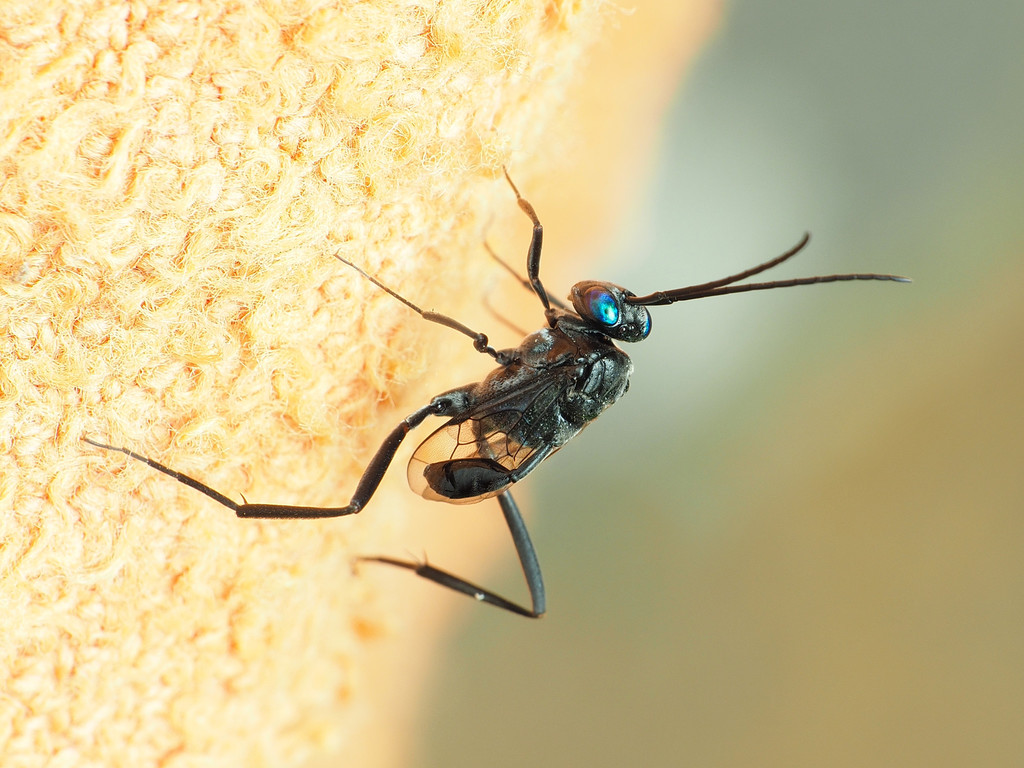
Blue-Eyed Ensign Wasp (Evania appendigaster) lives in tropical forests across Southeast Asia. It feeds on cockroach larvae only.
Fascinating facts about the Blue-Eyed Ensign Wasp
- The blue-eyed ensign wasp is one of the larger members of its family, with forewings that can stretch to about 7 millimetres. Its body is black with striking blue eyes, and the petiole that holds the gaster sits high on the thorax, giving the abdomen a flag-like silhouette that inspired the common name "ensign".
- When a female Evania appendigaster finds a cockroach ootheca, she spends a painstaking half-hour bracing her legs and drilling a tiny hole into the tough capsule, a process described as "hard labour". A 1920 account records that after settling on its side she extended her ovipositor and remained in position for about fifteen minutes while she punctured the fifth egg cell. The entire ritual can involve up to ten minutes of antenna drumming before the actual egg is deposited, highlighting the extreme effort required to parasitise each cockroach egg.
- Each cockroach egg capsule receives a single wasp egg, and the emerging larva must chew through the hard shell with its first-instar mandibles, which bear tiny sharp teeth. Over five instars the mandibles transform: the second and third instars develop longer, three-toothed "gauntlet-glove" jaws, while the final two instars grow a thick, blunt upper tooth and a narrow, curved lower tooth to crush the remaining eggs. When the larva reaches about 8 mm it pupates before emerging as an adult.
- Researchers see Evania appendigaster as a promising biological control agent against pest cockroaches. Laboratory studies show it can be bred, and its parasitising capacity rises with higher densities of host oothecae. However, development and parasitisation rates are temperature-dependent.
- After pupation the adult wasp cuts a hole in the egg capsule and exits. It lives for only two or three weeks. The wasp may be a candidate for use as an agent of biological pest control of cockroaches.
Sources
Every fact above was checked against these pages, and kept only where one of them states it.
At a glance
RangeSoutheast Asia
HabitatTropical forests
DietCockroach larvae only
About the Blue-Eyed Ensign Wasp
In the sweltering heat of tropical forests, the Blue-Eyed Ensign Wasp dances through the underbrush with an air of elegant precision, its iridescent blue eyes glinting like sapphires as it navigates the dense foliage with effortless ease. With its slender, metallic body glimmering in the dappled light, this wasp moves with a quiet confidence, its every step and flutter of its wings a testament to its remarkable adaptability in a world teeming with life. As it flits from leaf to leaf, the Blue-Eyed Ensign Wasp embodies a mesmerizing blend of fragility and resilience, a true marvel of evolutionary ingenuity.
Hear the Blue-Eyed Ensign Wasp, and 4,400+ more
Real recorded sounds, 11 nature games and a free Daily 5, 1v1 quiz duels, conservation wins and a safe Kids mode. Free on Feravox.
More insects and spiders to discover