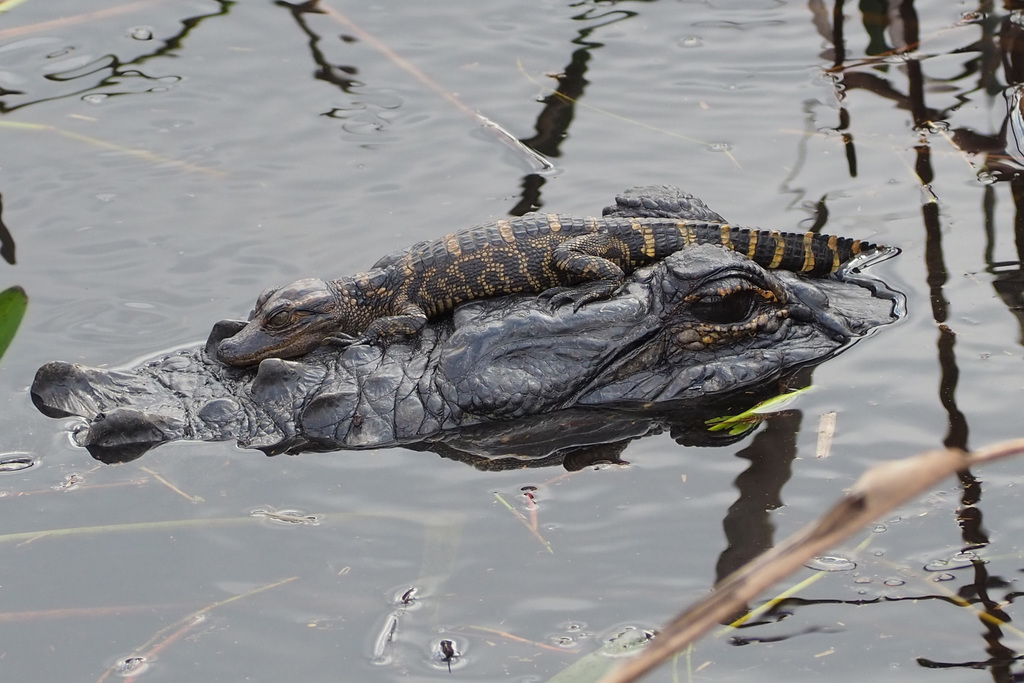
American Alligator (Alligator mississippiensis) lives in freshwater swamp and marsh across Southeastern United States. Its conservation status is Least Concern.
Hear the American Alligator
A real field recording of the American Alligator, made in the wild.
Adult male American alligators have reported unverified lengths up to 5.84 m (19.2 ft) and unverified weights of about 1,000 kg (2,200 lb), making them the heaviest members of Alligatoridae. Most males fall between 3.4 m and 4.8 m long and weigh as much as 450 kg, while females are smaller at 2.6 m to 3.35 m. They create the large "alligator holes" that other species depend on for refuge.
When a bite is measured in a lab, an adult American alligator can generate a jaw force of 13,172 N (2,961 lbf), the strongest recorded for any living animal. This power reinforces its role as an apex predator that controls fish and mammal populations and maintains healthy wetland ecosystems.
In North Carolina's PFAS-contaminated Cape Fear River, blood tests on 49 captured alligators found elevated levels of 14 different forever chemicals and a striking number of infected, unhealed lesions. The chemicals appear to blunt the gator's normally powerful immune response, turning a top predator into a sentinel for environmental health threats.
A 36-year study of alligators in South Carolina showed they stop growing once they hit a certain age, about 43 years for males and 31 years for females. This determinate growth contradicts the old belief that crocodilians grow forever.
Mother alligators guard their nests, carry hatchlings to water, and continue to look after them for up to three years, a rare level of parental care among reptiles.
Sources
Every fact above was checked against these pages, and kept only where one of them states it.
As the American alligator glides effortlessly through the murky waters of the southeastern swamplands, its ancient, armored form seems to embody the very essence of primordial power, its scaly hide glistening like polished ebony in the dappled sunlight. With a slow, deliberate movement, it navigates the tangled vegetation, its tail swishing sinuously behind it, leaving a trail of subtle ripples in its wake. In this realm of twisted cypress and Spanish moss, the alligator reigns supreme, a remarkable testament to the enduring legacy of a species that has remained largely unchanged for millennia.
Advertisement
Hear the American Alligator, and 4,400+ more
Real recorded sounds, 11 nature games and a free Daily 5, 1v1 quiz duels, conservation wins and a safe Kids mode. Free on Feravox.